Pearly penile papules can cause concern because they may resemble other types of genital bumps. However, they are a benign anatomical variation, not a sexually transmitted infection, and they are not caused by poor hygiene. For patients who feel self-conscious about their appearance, CO₂ laser treatment may be considered after an evaluation with our board-certified dermatologist, William Groff, DO.
What are Pearly Penile Papules?
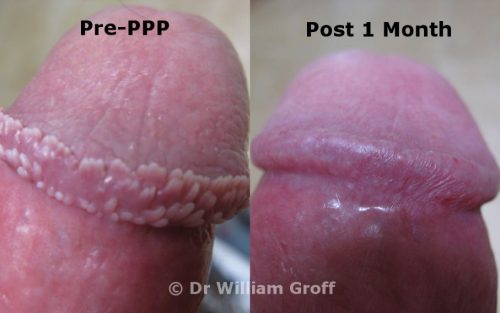
Pearly penile papules, also called hirsutoid papillomas, are small, benign bumps that typically appear in one or more rows around the corona of the penis. They may be skin-colored, white, pink, or yellow, and usually have a uniform, symmetrical appearance.
PPPs are not contagious, do not result from poor hygiene, and generally do not require medical treatment. They usually cause no symptoms beyond their appearance, although some patients seek treatment because the bumps create embarrassment, anxiety, or uncertainty.
What Are the Most Common Myths About Pearly Penile Papules?
Because people are usually uneducated about pearly penile papules, it’s important to address the common misconceptions that often times surround the disorder. Dr. Groff, a cosmetic laser dermatologist in San Diego, wants his patients to understand the truths surrounding PPP.
Are Pearly Penile Papules an STI?
No. PPPs are not caused by a sexually transmitted infection and cannot be passed to a partner through sexual contact.
Are Pearly Penile Papules Genital Warts?
No. Genital warts are associated with human papillomavirus, whereas PPP are benign anatomical variants. Their appearance and distribution are also typically different.
Are Pearly Penile Papules Caused by Poor Hygiene?
No. PPPs are not related to cleanliness, sexual activity, or personal hygiene. Their exact cause is not fully understood.
Are Pearly Penile Papules Dangerous?
No. PPPs are harmless and do not usually require treatment. Removal is generally considered for personal or cosmetic reasons rather than medical necessity.
How Can You Tell PPP From Genital Warts?
PPPs usually appear as uniform, smooth bumps arranged symmetrically around the edge of the glans. Genital warts may be more irregular in shape, vary in size, and appear in other genital locations.
Molluscum contagiosum, Fordyce spots, and other skin conditions may also resemble penile papules. For this reason, patients should not diagnose genital bumps from photographs alone. A board-certified dermatologist can often identify PPP through a physical examination and may use dermoscopy when additional clarification is needed.
When Should Penile Bumps Be Evaluated?
PPPs generally have no symptoms beyond their appearance. However, bumps should be evaluated when they:
- Appear suddenly or change noticeably
- Cause itching, pain, burning, or bleeding
- Produce discharge
- Spread beyond the typical area
- Develop after a new sexual contact
- Do not resemble uniform rows around the corona
- Create uncertainty or significant anxiety
Additional symptoms may indicate another condition that requires diagnosis or treatment. A professional evaluation can provide reassurance while helping rule out infections or other skin concerns.
How Does CO₂ Laser Treatment for PPP Work?
CO₂ laser treatment uses controlled energy to precisely target individual papules while limiting unnecessary effects on surrounding tissue. Local numbing is applied before treatment to support comfort, and the sensitive area is treated carefully and methodically.
As healing begins, controlled laser treatment supports fibroblastic function and enhances hyaluronic acid, collagen, and elastic fiber production. However, the primary purpose of the procedure is the precise reduction of visible papules rather than general skin rejuvenation.
The number of papules, their location, and the extent of the treatment area can influence the treatment plan.
What Is Recovery Like After PPP Laser Treatment?
Temporary redness, swelling, crusting, tenderness, and sensitivity may occur after CO₂ laser treatment. Patients receive specific aftercare instructions that may cover cleansing, ointment use, clothing, exercise, sexual activity, and follow-up care.
Many patients experience meaningful healing within the first one to two weeks. However, recovery varies depending on the extent of treatment, the number of papules treated, and the patient’s individual healing response.
Following aftercare instructions is important for protecting the treated area and reducing the risk of irritation, infection, pigment changes, or scarring. Patients should also avoid attempting to remove PPP at home with acids, wart products, cutting tools, or unapproved topical products.
Why Choose Dr. William Groff for PPP Treatment?
Dr. William Groff has extensive experience evaluating and treating pearly penile papules with precise CO₂ laser procedures. Treatment is performed in a private medical setting, where patients receive a confidential consultation and an individualized treatment plan based on the number, size, and location of the papules.
Cosmetic Laser Dermatology also offers access to advanced laser technology and care from board-certified dermatologists with extensive experience in laser medicine. This allows patients to receive discreet, medically guided treatment rather than attempting unsafe removal methods at home.
Explore Pearly Penile Papules Treatment in San Diego
Pearly penile papules are harmless, but treatment may be considered when their appearance affects confidence or creates ongoing concern.
Schedule a confidential consultation with Dr. William Groff at Cosmetic Laser Dermatology in San Diego to learn whether CO₂ laser treatment may be appropriate.

Dr. William Groff is a board-certified dermatologist and dermatologic cosmetic surgeon at Cosmetic Laser Dermatology in San Diego. With more than 25 years of experience, he specializes in cosmetic dermatology, laser surgery, facial and body rejuvenation, injectables, body contouring, and liposculpture. Dr. Groff is also the innovator behind the proprietary Take10 treatment and regularly lectures on advances in laser surgery and cosmetic dermatology.